Here is a version of our final coursework. It is perfectly watchable small screen but the full quality is on the DVD version, which we recommend you watch for its truer depiction of our work:
Showing posts with label Michaella. Show all posts
Showing posts with label Michaella. Show all posts
Monday, 22 April 2013

Monday, 1 April 2013
Evaluation of Appeal of Our Film to Audience
Our evaluation of the ways in which we hope our film will attract our target audience. Please pause to read individual comments more slowly. This is also intended to be viewed on DVD as it is one of the extras often provided.
Progress in Research and Planning
Prelim:
We did not have a chosen target audience for our prelim task, we given an outline of a situation that we had to follow and certain criteria that had to be met, such as: dialogue, someone walking out of the scene, and shot reverse shot. We did not create a storyboard for this piece.
Our prelim did not follow a specific genre type, therefore we did not have any music playing that would relate to the genre nor did we have a script.
It is therefore not surprising that the sequence feels disjointed and does not convey any real meaning to the audience.
Final Task:
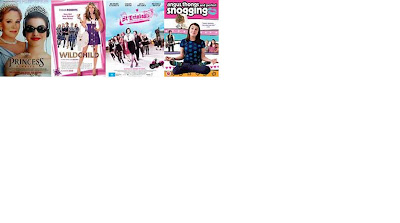
We watched the opening of many films from our chosen genre of Chick Flicks. This enabled us to recognise common techniques for the genre in terms of camera angles, sound, editing and mise-en-scene, for example being set in a school, having girls as the main characters, and the use of non-transparent very visible editing to create a fun and light-hearted feel.
 For our final task we produced a storyboard, which included every shot, with the decided composition and specific camera movements. We decided not to include much dialogue in our final piece as dialogue is introduced at the end of the first two minutes as we found in our research of our chosen genre.
Progress:
The fact that we conducted all this research for the final task helped us identify the specific elements that had to be included in our piece, which we did not focus on in the prelim task. Therefore making is easier to identify the genre of the piece.
Progress in Storyboarding and Scripting
Prelim:
For prelim task we didn't have a story board or a script. We were given a basic outline of what turns the piece had to take and basically made it upon the spot. Our planning was disorganised, we chose where we were going to film on the spot, obviously this wasn't thought through as well as it should have been, because the lack of space caused framing issues.
Final Task:
In contrast we planned out each scene and drew each shot so we knew exactly what we were doing when we turned up to our filming location. In fact, our storyboard went through several drafts and was detailed by the time we came to film:
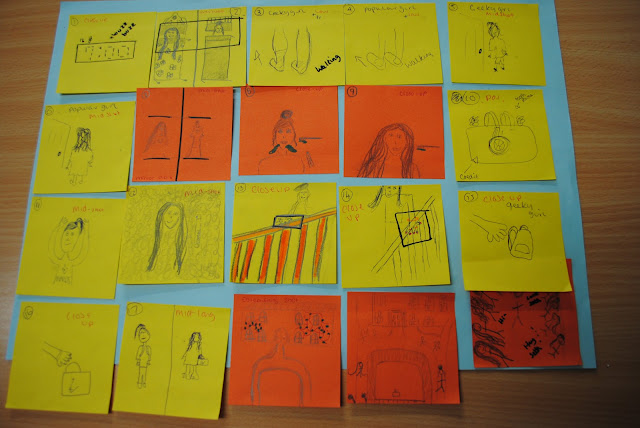
We had written up a script previously so we knew what was being said, but on the first day of filming we improvised what the girls would say to their mothers and they were leaving, so not everything was as fully planned out as we hoped, but still much improved from the prelim task.
We put much more thought into our location, but again we still had to work with what worked best and what was best and easiest for us in general. For example, when we were filming in the bathroom, space was an issue, but worked best for the shot. Also, proximity to the school had to be taken into consideration when choosing our location due to limited time and locations.
Our piece makes more sense than our prelim tasks, this is because no planing was involved when making our prelim therefore it was a bit random.
With our piece it is clear to the audience what is going on. Our storyboard helped us when filming- we were able to refer to it during production whereas we had nothing of the sort during our prelim task.
Progress in Camera Work
Prelim:
We used the tripod for the entire thing, we encountered problems when we were trying to keep the tripod straight, this made some of our shots off balance. We still werent familiar with using the camera at the time, and our planning and how we developed the characters wasn't good.
Camera movements were tricky for example we cut off Rebekah's head a couple of times so the piece didn't look very professional and gave it an unfinished look.
We struggled to use playback when filming the prelim and we recorded over work. Also as we struggled to use it, we didn't watch over what we had filmed so were unable to see what problems we needed to amend.
As we were new to using the camera and how to move them, we struggled to make out tracking shot look effective and have a smooth finish.
Final Task:
This time round we were much more confident with the use of the camera and tripod, making it easier to film. From previous experience we thought that using the tripod throughout the filming was appropriate for our particular production. Although we were confident with the camera we did have to re-film certain moments in our piece where we used handheld camera instead of a tripod.When we watched this back we realised the shots were evidently moving, giving it an untidy finish.Therefore we switched to filming these parts with a tripod, and this created a steady shot.
We found major improvements with our camera work from when we filmed our prelim task. Although we did not use any of our panning shots in our final piece (as it did no fit in with the film) they were much tidier than the prelim task panning shots. Our panning shots were more professional and smooth showing big progress in our camera work.
We naturally used a much wider range of camera angles and distances due to having planning time and a whole day of filmin as an initial shoot with pick ups on other days, whereas in our prelim task we only had a lesson period.
Progress in Editing
Prelim:
In our prelim task we were inexperienced with Final Cut Express and this meant that the editing was a slow process.
We weren't familiar with the continuity issues that could occur, and the fact that two different shots could jump because of a gap in editing. This occurred in our prelim task when there is a jump between two shots because we did not check it in editing.
We did not have any sound apart from dialogue and did not have any experience of using Live Type for credits.
Final Task:
We used layering capacity of Final Cut more effectively to achieve our effects of credits, split screen, and using a page turn effect.
We were more careful with continuity as we understood from our prelim task that it easy to make a mistake. We did this by enlarging the tracks to check we were cutting at exactly the right moment for continuity to be perfectly precise.
We used effects and transitions carefully for example making sure that the page turns were at the right moment, and making sure that the non-diegetic music faded in and out at the right time so the dialogue could be heard.
We included titles, credits and production idents using other programmes such as Livetype, and Photoshop and imported these into our piece. We gained experience from using these where we had no experience from our prelim task. We also used Photoshop to animate our ident:
Progress
We gained a greater understanding of the potential of the editing packages and how they can be combined.
We used a large range of effects
A more layered product created
Editing was less time consuming as we were confident with the tools and layout of the site.
Prelim:
We did not have a chosen target audience for our prelim task, we given an outline of a situation that we had to follow and certain criteria that had to be met, such as: dialogue, someone walking out of the scene, and shot reverse shot. We did not create a storyboard for this piece.
Our prelim did not follow a specific genre type, therefore we did not have any music playing that would relate to the genre nor did we have a script.
It is therefore not surprising that the sequence feels disjointed and does not convey any real meaning to the audience.
Final Task:
We watched the opening of many films from our chosen genre of Chick Flicks. This enabled us to recognise common techniques for the genre in terms of camera angles, sound, editing and mise-en-scene, for example being set in a school, having girls as the main characters, and the use of non-transparent very visible editing to create a fun and light-hearted feel.
Progress:
The fact that we conducted all this research for the final task helped us identify the specific elements that had to be included in our piece, which we did not focus on in the prelim task. Therefore making is easier to identify the genre of the piece.
Progress in Storyboarding and Scripting
Prelim:
For prelim task we didn't have a story board or a script. We were given a basic outline of what turns the piece had to take and basically made it upon the spot. Our planning was disorganised, we chose where we were going to film on the spot, obviously this wasn't thought through as well as it should have been, because the lack of space caused framing issues.
Final Task:
In contrast we planned out each scene and drew each shot so we knew exactly what we were doing when we turned up to our filming location. In fact, our storyboard went through several drafts and was detailed by the time we came to film:
We had written up a script previously so we knew what was being said, but on the first day of filming we improvised what the girls would say to their mothers and they were leaving, so not everything was as fully planned out as we hoped, but still much improved from the prelim task.
We put much more thought into our location, but again we still had to work with what worked best and what was best and easiest for us in general. For example, when we were filming in the bathroom, space was an issue, but worked best for the shot. Also, proximity to the school had to be taken into consideration when choosing our location due to limited time and locations.
Our piece makes more sense than our prelim tasks, this is because no planing was involved when making our prelim therefore it was a bit random.
With our piece it is clear to the audience what is going on. Our storyboard helped us when filming- we were able to refer to it during production whereas we had nothing of the sort during our prelim task.
Progress in Camera Work
Prelim:
We used the tripod for the entire thing, we encountered problems when we were trying to keep the tripod straight, this made some of our shots off balance. We still werent familiar with using the camera at the time, and our planning and how we developed the characters wasn't good.
 |
| Tripod off balance |
 |
| Poor framing |
 |
| Poor composition of shot |
 |
| Did not notice person in background while filming |
Camera movements were tricky for example we cut off Rebekah's head a couple of times so the piece didn't look very professional and gave it an unfinished look.
We struggled to use playback when filming the prelim and we recorded over work. Also as we struggled to use it, we didn't watch over what we had filmed so were unable to see what problems we needed to amend.
As we were new to using the camera and how to move them, we struggled to make out tracking shot look effective and have a smooth finish.
Final Task:
This time round we were much more confident with the use of the camera and tripod, making it easier to film. From previous experience we thought that using the tripod throughout the filming was appropriate for our particular production. Although we were confident with the camera we did have to re-film certain moments in our piece where we used handheld camera instead of a tripod.When we watched this back we realised the shots were evidently moving, giving it an untidy finish.Therefore we switched to filming these parts with a tripod, and this created a steady shot.
We found major improvements with our camera work from when we filmed our prelim task. Although we did not use any of our panning shots in our final piece (as it did no fit in with the film) they were much tidier than the prelim task panning shots. Our panning shots were more professional and smooth showing big progress in our camera work.
We naturally used a much wider range of camera angles and distances due to having planning time and a whole day of filmin as an initial shoot with pick ups on other days, whereas in our prelim task we only had a lesson period.
Progress in Editing
Prelim:
In our prelim task we were inexperienced with Final Cut Express and this meant that the editing was a slow process.
We weren't familiar with the continuity issues that could occur, and the fact that two different shots could jump because of a gap in editing. This occurred in our prelim task when there is a jump between two shots because we did not check it in editing.
We did not have any sound apart from dialogue and did not have any experience of using Live Type for credits.
Final Task:
We used layering capacity of Final Cut more effectively to achieve our effects of credits, split screen, and using a page turn effect.
 |
| Page curl |
 |
| Split screen and credits |
We were more careful with continuity as we understood from our prelim task that it easy to make a mistake. We did this by enlarging the tracks to check we were cutting at exactly the right moment for continuity to be perfectly precise.
We used effects and transitions carefully for example making sure that the page turns were at the right moment, and making sure that the non-diegetic music faded in and out at the right time so the dialogue could be heard.
We included titles, credits and production idents using other programmes such as Livetype, and Photoshop and imported these into our piece. We gained experience from using these where we had no experience from our prelim task. We also used Photoshop to animate our ident:
 |
| Ident on Photoshop |
Progress
We gained a greater understanding of the potential of the editing packages and how they can be combined.
We used a large range of effects
A more layered product created
Editing was less time consuming as we were confident with the tools and layout of the site.
Evaluation of what we have learned about Technologies
Please use the link below to see our presentation discussing what we have learned about technologies through carrying out our coursework:
Presentation on Slideshare but better quality on DVD!
Presentation on Slideshare but better quality on DVD!
Monday, 11 March 2013
Evaluate how your product used, developed, or challenged the forms and conventions of real media products.
Title
- We chose large bubble writing for our title, which appears in pink on the first page of the photo album.
- Fits well as the colour pink connotes girly things, so it suggests from the outset that this is a teen drama aimed towards females.
Credits
- We chose a plain white font for our credits, as they showed up well against the pink background
Characters
- Our main characters are young females.
- We cast two young females as the main characters as this is fitting with our genre, and also relevant and relatable to our target audience, as the majority of the time in a Chick Flick the main character/s is a girl.
- The love interest is a white male. He’s appearance fits into the stereotypical gender conventions of being the attractive boyfriend of one of the key characters, e.g. ‘Aaron Samuels’ the boyfriend of the popular ‘Regina George’ in ‘Mean Girls’.
- The girls in the corridor scene are made to seem intimidating and clique-ish, as we got them all to stand together gossiping.

- The cast that we use all create a high sense of verisimilitude as they all look as though they are the right age to be in school.
Mise en scène
- Typically, chick flicks that are aimed at our audience are set in scenes that the majority can relate to, such as a high school
- Used props such as books and notepads to create a high sense of verisimilitude, as these would be common in a stereotypical high school.
- One of our scenes was set in Charlie’s bathroom – we used props such as perfume bottles and hair products to exaggerate her lifestyle.

- We cast Rachel as Rosie, she is smaller than Becca, who plays Charlie, which helps indicate to the audience who is in the position of power, as Charlie is constantly looking down at/on Rosie.
- We got Rachel to carry a rucksack and Becca to carry a handbag to highlight the juxtaposition we were trying to create. Also rucksacks connote studying and ‘geekiness’, whereas handbags are seen as more glamorous and feminine. Use of props to establish character is common in our genre.
Camera Work
- Used a close up on Charlie’s face in order to enable to audience to gauge her reaction, also this may have caused the audience to dislike Charlie as they’re able to see her facial expression and she looks really angry and indignant, when clearly Rosie’s done nothing wrong, which will hopefully cause the audience to sympathise with Rosie.

- We used shot reverse shot – a typical technique of all genres, used often when filming a conversation- to film Rosie and Charlie talking at the bottom of the stairs.
- We used lots of close ups at the start of the piece when the girls were getting ready, so that the audience could familiarize themselves with the characters. Convention of all openinf sequences, not only our genre.
- This can be typical in chick flicks as they help highlight who the main characters are and what significance they have to the story.
Editing
- We used a page turn transition to smooth the cuts from scene to scene, and from the split screens to the full screen.- these just made it more obvious to the audience that the current scene was over and helped create the photo album feel, as if we are seeing a snapshot of their lives. This photo effect is common in the genre.

- We also used a fade transition to show the establishing shot of the school - conventional technique in fast-moving film openings.
- We decided to cross cut between the two main characters at the start, to highlight the juxtaposition between their morning routine. This technique is commonly used in the TV Drama ‘Glee’, which has a high amount of female viewers.
Sound
- We used two main sound elements, the first piece of non-diegetic music plays over the scenes where the two main characters are getting ready, and the other starts at the establishing shot of the school and continues through till the end of the piece.
- The music is has a pop feel, and is quite girly, so it gives an upbeat feeling to the film. The non diegetic sound used at the start is also quite happy and upbeat, so I think it’s relevant to be used in the part where the girls are getting up, and getting ready.
- The dialogue used in our film demonstrates the power between the two main characters, as Charlie has a lot more dialogue than Rosie, with Charlie saying long sentences and Rosie just giving short answers
Thursday, 7 March 2013

Thursday, 21 February 2013
Evaluation of Distribution Institution for Film
Please view on DVD out of preference as this is a DVD extra product and appears in its highest quality there.
From left to right: Rebecca, Rebekah, Rachel. On screen: Michaella
Thursday, 14 February 2013
Evaluation Of Representation of Specific Social Groups
Representation of Teenage Girls
- Two main representations – 1st created by Rosie –Tomboyish. 2nd by Charlie – Girly.
- Slightly clichéd and more American, but familiar to our audience as they are familiar media stereotypes- in ‘Mean Girls’ as well.
- Expectation is that the moment the stereotype is identified, the audience will relax and look forward to watching events they can predict unfold.
- Predicatability associated with genre texts (Neale) but does lead to narrow range of highly exaggerated representations (Lacey).
- Some critics feel these can be harmful (Pickering) while others feel they "do no harm" if audience recognise them as a plot device and not related to reality (Dyer)
 |
| 'Cady' from 'Mean Girls' |
 |
| 'Karen, Regina and Gretchen' from 'Mean Girls' |
- These representations often the ones most frequently used in teen dramas –also created in the film ‘10 Things I Hate About You’ with ‘Kat’ and ‘Bianca’


- In ’10 Things I Hate About You’ it’s made obvious to the audience that Kat is the ‘loner’ and Bianca is the ‘popular’ one.
- We have tried to replicate this, by composing the shot in the hallway to show Charlie surrounded by friends and Rosie being on her own.

- Minimal dialogue used in our piece and '10 Things I Hate About You’opening – gives audience chance to get to know the characters through their movements, facial expressions and non-diegetic music
- At start, negative representation is created of popular girls. Intentional - wanted the audience to feel sympathetic towards Rosie. The popular girls behaviour isn’t extreme so our piece shouldn’t be harmful towards our audience or affect real life perceptions, as
- I agree with Dyer, who suggests that the audience are good at separating media from reality and stereotypes are not bad as long as they ‘do not harm’
- I expect that our audience will be able to differentiate between the stereotypes created in our piece and real life, as they will have first hand experience of being in school and in that environment. Representations more potentially harmful when take audience outside their own experience and they don't have own experiences to compare against (Hartley)
- Through the use of mise-en-scene, we’ve tried to create juxtaposition through costume and props, Charlie’s room is really girly and colourful, her costume is a pink dressing gown, and when she’s getting ready she’s surrounded by beauty products. In contrast, Rosie’s room is very simple, basic colours like white and blue feature.

- Paired with split screen to show contrast between characters - may highlight to audience derogatory stereotypes about women – our opening focuses a lot on girls getting ready - stereotypically women take a long time to get ready - might reinforce negative stereotype through repetition of it.

- However, this character clearly 'villain' at beginning - not aspirational and comic exaggeration weakens stereotyping.
Wednesday, 13 February 2013
Sunday, 3 February 2013
Cut for Audience Feedback
This cut is further back than the original one we put up in terms of being ready as we ended up refilming a lot of the bedroom sections so we haven't had much time to put it together. It is more like a collection of the clips we are going to use:
A more updated version!
A more updated version!
Wednesday, 23 January 2013
Progress With Editing
We have just begun editing and we are putting our clips together on the timeline:


This is a cut of our piece which is like a first cut:
Tuesday, 11 December 2012


Monday, 10 December 2012
Researching Target Audience

Here are my initial notes around target audience. In some ways there doesn't seem much to say as there is such an obvious target group for our film - chick flicks are clearly aimed at females, and as we have a,lot of cross-over with teen drama, we are aiming at the younger end of the market. Previously successful films show that this is a lucrative market to aim at and that films in this genre can be successful.
However, when we started thinking about it more, it did occur to us that older women also watch chick flicks (the 'Twilight moms' have become well known, for example) and the comnedy element of these films mean that they can make good date movies and also have something to offer a male audience. Therefore although we expect our main audience to be younger women, we don't want to exclude any potential audience from our thinking. Humour is the easiest way to widen the appeal of this kind of film and there has been a rise in romance-based films aimed more at men (Knocked Up) because of the kind of humour involved. We need to make sure there is a comic slapstick moment early in our sequence. This article suggests many romance-based films appeal to men:
http://www.cinemablend.com/new/15-Romantic-Movies-Men-Should-Love-16998.html
so we do not wish to exclude a male target audience.
Monday, 3 December 2012
Research Into Film Industry
Research Into The Film Industry
Eon Productions are a British Production Company, most well known for producing the James Bond films – they've actually only made 1 non James Bond film – so although they are quite small, family owned and based in London, their films attract and interest millions of people all over the world.




Every film starts with its production. A film producer comes up with an idea, or buys the rights to an idea off someone, and gives it to writers, who can then change and adapt the idea into a sell-able commercial story. The writer would then create the script to go with the story.
They also have to raise the funds in order to be able to shoot/create the film. The producers can do this by approaching large companies who can back the film; the producers agree to give those companies a percentage of the profits if they invest in the project. Some of these companies might be Coca Cola, McDonalds, etc.
Production Companies:
Working Title Productions are a British Production Company, most well known for films like Nanny McPhee, Notting Hill, Hot Fuzz and Bridget Jones’ Diary. Most of their films are set in Britain , using British actors, yet people all over the world watch their films.
Warner Brothers is a massive American film production company, and are responsible for the creation of many well-known films, such as The Hangover, The Looney Tunes, The Hobbit, and Journey To The Centre Of The Earth. They also own over 7 subsidiary companies, whilst still being a subsidiary company themselves, owned by Time Warner. Warner Brothers produce many films each year, sometimes on half of other companies, and their audience is worldwide.
The experts who know all about films are hired in this stage, the Directors, the Crew, and the Cast is determined. This can take a long as time as the Producers have to make sure that they find people who are right to play the part in their film, and they may have a lot of choice, especially if they are a large production company.
Martin Scorsese, famous film Director
The locations for filming, props and costumes are all sorted out in the Production stage as well. This can also take a long time as scouts are sent out so that the right location can be found, permission to film is often needed as it may get in the way of everyday life. For example, in the making of Harry Potter and the Deathly Hallows Part 1, part of Piccadilly Circus in London was shut off to the public, a red bus, an ambulance and multiple police cars were used to create the scene.

The Distribution then begins.
The producers can agree with distribution companies, who will be able to ensure that the film trailers/posters etc are seen by the masses, and so hopefully that will create a large profit, a percentage of which will go to the distribution companies.
Embassy Productions, a Distribution Company
The distribution companies then negotiate with the Cinema companies how many screenings of that film will be shown, if the film is predicted to be a huge success then the distribution companies will most likely have an easier time securing the screening times than other companies competing with other movies.
They also set a date for when the film is going to be released, which can be different from country to country, and the company also handles things like the box sets, DVDS, merchandise, and the films availability on online/tv libraries such as Sky and Netflix.
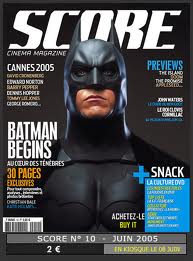
Batman Begins Box Set, Limited Edition
Batman Merchandise
Sky Anytime
Netflix
Marketing:
One of the most popular methods are posters/billboards, as these can easily be printed in numerous languages, and can be put in many different places so that the public sees them, like in:
Magazines:
Billboards:
Bus Stops:
Cinemas:
'Friends With Benefits' Poster in Spanish
By having the films being shown in different languages creates a lot more profit, and having advertisement at places like Bus Stops is really effective in showing masses of people what the film is, who's playing the characters, when it's out etc, because people aren't on the move, and have a bigger chance of seeing and reading what the advertisement says. Similarly with Billboards, if people are stuck in traffic, its something to catch their interest, and people can see it from a quite a distance away, so that increases the number of people that are viewing it each day.
Subscribe to:
Posts (Atom)