Here is a version of our final coursework. It is perfectly watchable small screen but the full quality is on the DVD version, which we recommend you watch for its truer depiction of our work:
Showing posts with label Rebekah O. Show all posts
Showing posts with label Rebekah O. Show all posts
Monday, 22 April 2013

Monday, 1 April 2013
Evaluation of Appeal of Our Film to Audience
Our evaluation of the ways in which we hope our film will attract our target audience. Please pause to read individual comments more slowly. This is also intended to be viewed on DVD as it is one of the extras often provided.
Progress in Research and Planning
Prelim:
We did not have a chosen target audience for our prelim task, we given an outline of a situation that we had to follow and certain criteria that had to be met, such as: dialogue, someone walking out of the scene, and shot reverse shot. We did not create a storyboard for this piece.
Our prelim did not follow a specific genre type, therefore we did not have any music playing that would relate to the genre nor did we have a script.
It is therefore not surprising that the sequence feels disjointed and does not convey any real meaning to the audience.
Final Task:
We watched the opening of many films from our chosen genre of Chick Flicks. This enabled us to recognise common techniques for the genre in terms of camera angles, sound, editing and mise-en-scene, for example being set in a school, having girls as the main characters, and the use of non-transparent very visible editing to create a fun and light-hearted feel.
 For our final task we produced a storyboard, which included every shot, with the decided composition and specific camera movements. We decided not to include much dialogue in our final piece as dialogue is introduced at the end of the first two minutes as we found in our research of our chosen genre.
Progress:
The fact that we conducted all this research for the final task helped us identify the specific elements that had to be included in our piece, which we did not focus on in the prelim task. Therefore making is easier to identify the genre of the piece.
Progress in Storyboarding and Scripting
Prelim:
For prelim task we didn't have a story board or a script. We were given a basic outline of what turns the piece had to take and basically made it upon the spot. Our planning was disorganised, we chose where we were going to film on the spot, obviously this wasn't thought through as well as it should have been, because the lack of space caused framing issues.
Final Task:
In contrast we planned out each scene and drew each shot so we knew exactly what we were doing when we turned up to our filming location. In fact, our storyboard went through several drafts and was detailed by the time we came to film:
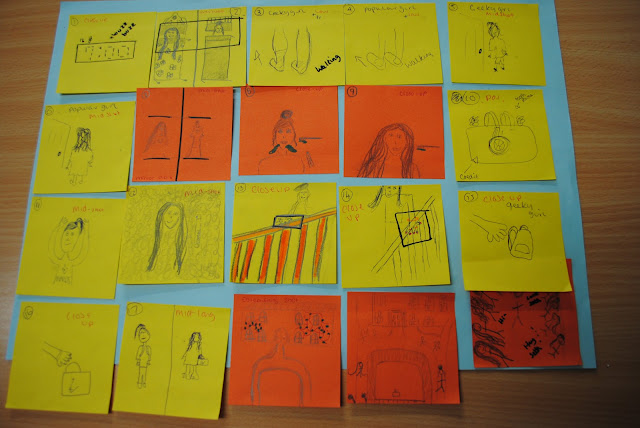
We had written up a script previously so we knew what was being said, but on the first day of filming we improvised what the girls would say to their mothers and they were leaving, so not everything was as fully planned out as we hoped, but still much improved from the prelim task.
We put much more thought into our location, but again we still had to work with what worked best and what was best and easiest for us in general. For example, when we were filming in the bathroom, space was an issue, but worked best for the shot. Also, proximity to the school had to be taken into consideration when choosing our location due to limited time and locations.
Our piece makes more sense than our prelim tasks, this is because no planing was involved when making our prelim therefore it was a bit random.
With our piece it is clear to the audience what is going on. Our storyboard helped us when filming- we were able to refer to it during production whereas we had nothing of the sort during our prelim task.
Progress in Camera Work
Prelim:
We used the tripod for the entire thing, we encountered problems when we were trying to keep the tripod straight, this made some of our shots off balance. We still werent familiar with using the camera at the time, and our planning and how we developed the characters wasn't good.
Camera movements were tricky for example we cut off Rebekah's head a couple of times so the piece didn't look very professional and gave it an unfinished look.
We struggled to use playback when filming the prelim and we recorded over work. Also as we struggled to use it, we didn't watch over what we had filmed so were unable to see what problems we needed to amend.
As we were new to using the camera and how to move them, we struggled to make out tracking shot look effective and have a smooth finish.
Final Task:
This time round we were much more confident with the use of the camera and tripod, making it easier to film. From previous experience we thought that using the tripod throughout the filming was appropriate for our particular production. Although we were confident with the camera we did have to re-film certain moments in our piece where we used handheld camera instead of a tripod.When we watched this back we realised the shots were evidently moving, giving it an untidy finish.Therefore we switched to filming these parts with a tripod, and this created a steady shot.
We found major improvements with our camera work from when we filmed our prelim task. Although we did not use any of our panning shots in our final piece (as it did no fit in with the film) they were much tidier than the prelim task panning shots. Our panning shots were more professional and smooth showing big progress in our camera work.
We naturally used a much wider range of camera angles and distances due to having planning time and a whole day of filmin as an initial shoot with pick ups on other days, whereas in our prelim task we only had a lesson period.
Progress in Editing
Prelim:
In our prelim task we were inexperienced with Final Cut Express and this meant that the editing was a slow process.
We weren't familiar with the continuity issues that could occur, and the fact that two different shots could jump because of a gap in editing. This occurred in our prelim task when there is a jump between two shots because we did not check it in editing.
We did not have any sound apart from dialogue and did not have any experience of using Live Type for credits.
Final Task:
We used layering capacity of Final Cut more effectively to achieve our effects of credits, split screen, and using a page turn effect.
We were more careful with continuity as we understood from our prelim task that it easy to make a mistake. We did this by enlarging the tracks to check we were cutting at exactly the right moment for continuity to be perfectly precise.
We used effects and transitions carefully for example making sure that the page turns were at the right moment, and making sure that the non-diegetic music faded in and out at the right time so the dialogue could be heard.
We included titles, credits and production idents using other programmes such as Livetype, and Photoshop and imported these into our piece. We gained experience from using these where we had no experience from our prelim task. We also used Photoshop to animate our ident:
Progress
We gained a greater understanding of the potential of the editing packages and how they can be combined.
We used a large range of effects
A more layered product created
Editing was less time consuming as we were confident with the tools and layout of the site.
Prelim:
We did not have a chosen target audience for our prelim task, we given an outline of a situation that we had to follow and certain criteria that had to be met, such as: dialogue, someone walking out of the scene, and shot reverse shot. We did not create a storyboard for this piece.
Our prelim did not follow a specific genre type, therefore we did not have any music playing that would relate to the genre nor did we have a script.
It is therefore not surprising that the sequence feels disjointed and does not convey any real meaning to the audience.
Final Task:
We watched the opening of many films from our chosen genre of Chick Flicks. This enabled us to recognise common techniques for the genre in terms of camera angles, sound, editing and mise-en-scene, for example being set in a school, having girls as the main characters, and the use of non-transparent very visible editing to create a fun and light-hearted feel.
Progress:
The fact that we conducted all this research for the final task helped us identify the specific elements that had to be included in our piece, which we did not focus on in the prelim task. Therefore making is easier to identify the genre of the piece.
Progress in Storyboarding and Scripting
Prelim:
For prelim task we didn't have a story board or a script. We were given a basic outline of what turns the piece had to take and basically made it upon the spot. Our planning was disorganised, we chose where we were going to film on the spot, obviously this wasn't thought through as well as it should have been, because the lack of space caused framing issues.
Final Task:
In contrast we planned out each scene and drew each shot so we knew exactly what we were doing when we turned up to our filming location. In fact, our storyboard went through several drafts and was detailed by the time we came to film:
We had written up a script previously so we knew what was being said, but on the first day of filming we improvised what the girls would say to their mothers and they were leaving, so not everything was as fully planned out as we hoped, but still much improved from the prelim task.
We put much more thought into our location, but again we still had to work with what worked best and what was best and easiest for us in general. For example, when we were filming in the bathroom, space was an issue, but worked best for the shot. Also, proximity to the school had to be taken into consideration when choosing our location due to limited time and locations.
Our piece makes more sense than our prelim tasks, this is because no planing was involved when making our prelim therefore it was a bit random.
With our piece it is clear to the audience what is going on. Our storyboard helped us when filming- we were able to refer to it during production whereas we had nothing of the sort during our prelim task.
Progress in Camera Work
Prelim:
We used the tripod for the entire thing, we encountered problems when we were trying to keep the tripod straight, this made some of our shots off balance. We still werent familiar with using the camera at the time, and our planning and how we developed the characters wasn't good.
 |
| Tripod off balance |
 |
| Poor framing |
 |
| Poor composition of shot |
 |
| Did not notice person in background while filming |
Camera movements were tricky for example we cut off Rebekah's head a couple of times so the piece didn't look very professional and gave it an unfinished look.
We struggled to use playback when filming the prelim and we recorded over work. Also as we struggled to use it, we didn't watch over what we had filmed so were unable to see what problems we needed to amend.
As we were new to using the camera and how to move them, we struggled to make out tracking shot look effective and have a smooth finish.
Final Task:
This time round we were much more confident with the use of the camera and tripod, making it easier to film. From previous experience we thought that using the tripod throughout the filming was appropriate for our particular production. Although we were confident with the camera we did have to re-film certain moments in our piece where we used handheld camera instead of a tripod.When we watched this back we realised the shots were evidently moving, giving it an untidy finish.Therefore we switched to filming these parts with a tripod, and this created a steady shot.
We found major improvements with our camera work from when we filmed our prelim task. Although we did not use any of our panning shots in our final piece (as it did no fit in with the film) they were much tidier than the prelim task panning shots. Our panning shots were more professional and smooth showing big progress in our camera work.
We naturally used a much wider range of camera angles and distances due to having planning time and a whole day of filmin as an initial shoot with pick ups on other days, whereas in our prelim task we only had a lesson period.
Progress in Editing
Prelim:
In our prelim task we were inexperienced with Final Cut Express and this meant that the editing was a slow process.
We weren't familiar with the continuity issues that could occur, and the fact that two different shots could jump because of a gap in editing. This occurred in our prelim task when there is a jump between two shots because we did not check it in editing.
We did not have any sound apart from dialogue and did not have any experience of using Live Type for credits.
Final Task:
We used layering capacity of Final Cut more effectively to achieve our effects of credits, split screen, and using a page turn effect.
 |
| Page curl |
 |
| Split screen and credits |
We were more careful with continuity as we understood from our prelim task that it easy to make a mistake. We did this by enlarging the tracks to check we were cutting at exactly the right moment for continuity to be perfectly precise.
We used effects and transitions carefully for example making sure that the page turns were at the right moment, and making sure that the non-diegetic music faded in and out at the right time so the dialogue could be heard.
We included titles, credits and production idents using other programmes such as Livetype, and Photoshop and imported these into our piece. We gained experience from using these where we had no experience from our prelim task. We also used Photoshop to animate our ident:
 |
| Ident on Photoshop |
Progress
We gained a greater understanding of the potential of the editing packages and how they can be combined.
We used a large range of effects
A more layered product created
Editing was less time consuming as we were confident with the tools and layout of the site.
Evaluation of what we have learned about Technologies
Please use the link below to see our presentation discussing what we have learned about technologies through carrying out our coursework:
Presentation on Slideshare but better quality on DVD!
Presentation on Slideshare but better quality on DVD!
Sunday, 10 March 2013
Evaluate Use of Conventions of 'Real' Media

Title
- We had pink text that appears in a 'girly' photo album which fits our target audience.
- Suits our genre as text font and movement are quite girly.
Credits
- The same font and style as main title.
- They appear as captions in a photo album which helps them fit in with the action. Also suggests a 'yearbook' kind of theme which corresponds well with our genre.
Characters and Themes
- Chick flicks mostly have romance and problems and the dilemmas that come with it, so we made sure that we had that for our characters to deal with.
- Characters usually deliver contrasts between different groups of people. We made sure that we clearly showed the different cliques. E.g. popular and unpopular.
- Generally in our genre there is always on character that portrays some empathy towards the underdog character. In our film that was 'Seth' showing empathy towards 'Rosie'.
- We followed the conventional characters you would usually see in our genre, the geek and the princess.
- Narrative develops out of these character types in our genre. Once the audience have established the role each character has, they will work out the probably narrative arc quite quickly.
Mise-En-Scene
- Chick flick/teen dramas are usually set in a school environment as it is where teens are most of the time - we followed this convention.
- The clothing helped to show the difference between the two types of characters. In our film handbags and pink fluffy dressing gown against a rucksack and blazer.
- We used props to show the difference between two types of characters. Make up against school books.
- The two girls' bedrooms that we filmed in helped to distinguish the difference between characters.
- We had others playing the popular girl's 'pose' which helped to make her seem more intimidating to the unpopular girl as she was on her own.
Camera work
- We used quite a few close ups on our characters in our film because we tried to let the audience know the emotions of characters.
- We used shot reverse shot just to show the characters feelings during conversations.
- We used a couple of two shots. This allowed us to show the difference of characters directly next to each other. In our genre this happens a lot.
Editing
- In post-production we added a split screen to help show the difference in character of the two girls. This also gave us a really good opportunity for the credits.
- We used slight ellipsis in places to keep it moving at a good pace instead of showing unnecessary things that slow down the pace of the film. This is particularly necessary in our opening where little really happens plot-wise so we have to capture interest in other ways.
- We used cross cutting at the start of the film. This helped to compare and introduce the two main characters to show their difference. Also it makes the scene interesting and to speed up the pace.
Sound
- Non-diegetic music is the main sound that plays through most of the film. It helps to get the feel of the film and establish the genre and mood for the audience.
- We went for the same style of music that most chick flick/teen dramas use as it is current and the type of music our target audience would listen to.
- Dialogue in our film helps to portray the character. This helps us to get the audience to feel how we want them to feel towards certain characters. For example, the popular girl says "Move, ginger" to the unpopular girl, which automatically makes the audience feel sympathetic towards the unpopular girl. This kind of overt dialogue is common in our genre.
We have followed a lot of genre conventions and our audience feedback made it clear that it is easy to work out what genre we are aiming for, so I think we have used the conventions successfully. I also think we have managed to keep to form conventions for opening sequences as we do not allow too much to happen and we establish our characters and a general atmosphere clearly. It would have been nice to add a genre twist, but our genre is so well established it would be difficult to do this in only two minutes, and would be unlikely to happen at the very beginning of the film.
Monday, 4 March 2013

Thursday, 21 February 2013
Evaluation of Distribution Institution for Film
Please view on DVD out of preference as this is a DVD extra product and appears in its highest quality there.
From left to right: Rebecca, Rebekah, Rachel. On screen: Michaella
Thursday, 14 February 2013
Evaluation of Representation of social groups in our film
Representation of Teenagers / Girls in Our Film


.jpg)

- As a chick flick, it seems productive to look at the representation of teenage girls in our film.
- A ‘Popular’ clique and a ‘nerdy group’- two classic teen stereotypes - both in our piece.
- We exaggerated the two different types that we were portraying to help make it easier for the audience to identify what type of character they each were - therefore the stereotyping becomes so obvious the audience is supposed to recognise it and be entertained by it.
- Also by exaggerating it helped to give our film a light hearted feel - comedy can undermine the stereotype by almost mocking it.
- A prime example of a film that exaggerates stereotypes a lot is 'Mean Girls' where they introduce the different groups and we see the exaggerated stereotypical perception of them, so our use of almost comic stereotypes is linked to our genre.
- By using split screens in places we were able to help show the clear difference between the different characters so the audience could clearly tell who they were/what type of person they were.
- Props and mise-en-scene in the split screen parts of our film helped to make this difference apparent. In Charley’s room/bathroom there was lots of make up and touches of pink and she wears a fluffy dressing gown whereas in Rosie’s room, there are lots of books, plain white sheets and she wears sensible pyjamas.
- Using mise en scene we were able to create the character that we wanted. Eg. Costume/hair/make up was very girly for the ‘popular’ and like a tomboy for the ‘nerd’
- Dialogue helped to create/ represent them in the way that we wanted. “Move, Ginger” was said by the popular girl to show that she was mean and looked down on people and that this is partly based on physical appearance.
- The way the frames were composed was similar to other films. The person that the audience was meant to feel sorry for is always on their own. Similar to films like ‘Mean Girls’ where the ‘popular’ ones are always in a group to be intimidating and the unpopular one looks vulnerable.

- We also used quite a few close ups that are used a lot in chick flicks. It helps to show how the characters feel towards to each other, especially how they feel about the other 'cliques'. A good example is in 'Angus, Thongs and Perfect Snogging'

- The non-diegetic music we used in our film made it clear that this film is light hearted and that the stereo types shouldn't be taken seriously even though you are meant to have empathy towards the characters. Again, we think this softens our representations and will position the audience to understand them the way we are intending - as a fun, light-hearted plot device rather than reality.
- In some chick flicks that contrast an unpopular girl and then a popular girl and her boyfriend, it is clear that the boyfriend is ruled by the popular girl but has sympathy for the unpopular girl. This is seen in films like ‘Mean Girls’ and ‘A Cinderella Story’
- We tried to make our film have this aspect, so when Rosie drops her books, Seth goes to help her. This helps to make show that even the popular people are not all bad and can be redeemed. In fact, this classic redemption narrative arc is what makes sure any negative aspects of our representation can be cancelled out. Ultimately all the differences between the teen groups are wiped out at the end. This could be criticised for representing teen life in an unrealistic way that 'real' teenagers cannot aspire to, but our genre needs a happy ending.

Wednesday, 13 February 2013
Sunday, 3 February 2013
Cut for Audience Feedback
This cut is further back than the original one we put up in terms of being ready as we ended up refilming a lot of the bedroom sections so we haven't had much time to put it together. It is more like a collection of the clips we are going to use:
A more updated version!
A more updated version!
Wednesday, 23 January 2013
Progress With Editing
We have just begun editing and we are putting our clips together on the timeline:


This is a cut of our piece which is like a first cut:
Wednesday, 12 December 2012
The Target Audience

.JPG)
I have carried out some research into target audience. I started with the official definition for my genre above and then looked to see how our plans for our film would work towards attracting this audience.
Our genre is one of the easiest to classify in terms of target audience. It is clearly aimed at a female audience and because we have some cross-over with teen drama, it is also clear that we are mainly going to be targeting teenagers. Therefore our main aim with audience is to make sure we provide the key features that teenage girls expect to see in these films - humour, interesting casting, up-to-date clothes and music, an accessible plot that has some kind of twist on a well known theme etc.
Tuesday, 11 December 2012


Tuesday, 4 December 2012
The Film Industry
Research into the Film Industry
Film institutions
Films institutions' most important aim is to make money. From all the films that are made they try and make the most profit possible. They have different stages of the film process that helps to maximise its ability to make money. This is through its production, distribution and marketing.
Production
Production companies are in charge of making the initial processes happen and get the resources and people to actually make the film.

 Receive script- They get the script that needs to be made into a film. Their job is to make the job more commercial. This makes the film easier to sell to the public and is more audience friendly.
 The distribution company is in charge of the part of the process that get the film out into the public.The film comes from the production company and then it is the distribution companies that are in charge of making sure that people watch it. They do this by ‘distributing’ the film. This can be done in various ways. The most common ones are by releasing in the cinema, on TV DVDs or on the internet. The more people that watch the film, the more money the film makes. For a series of successful films, they also tend to bring out box sets.

.jpg)
Film institutions
Films institutions' most important aim is to make money. From all the films that are made they try and make the most profit possible. They have different stages of the film process that helps to maximise its ability to make money. This is through its production, distribution and marketing.
Production
Production companies are in charge of making the initial processes happen and get the resources and people to actually make the film.
Receive script- They get the script that needs to be made into a film. Their job is to make the job more commercial. This makes the film easier to sell to the public and is more audience friendly.Raise money- The production company is then in charge of trying to raise money so that they have enough to actually make the film. They sometimes go to big organisations to give them some money. This then means that the organisations have shares in the film and get a percentage of the profit that the film makes. If not enough money can be made to be put into the film then the film cannot be made.
Employing- Their next job is to employ the people to make the film. Directors and director of photography are employed first and then the rest of the cast and crew. Along with this they have to get a location for the films and get the props and equipment that they will need to shoot the film.
Distribution
The distribution company is in charge of the part of the process that get the film out into the public.The film comes from the production company and then it is the distribution companies that are in charge of making sure that people watch it. They do this by ‘distributing’ the film. This can be done in various ways. The most common ones are by releasing in the cinema, on TV DVDs or on the internet. The more people that watch the film, the more money the film makes. For a series of successful films, they also tend to bring out box sets.Marketing
The marketing for films is one of the most important parts of the film industry. The marketing team have to ensure that people go and see the film and buy the merchandise and everything relating to the film. they try and do this by creating trailers, posters, and clips that try and make the target audience want to see the film. this is important because if no one was drawn in to see the film then no money would be made from it. If the marketing is bad then the whole project would be a waste.
Sunday, 2 December 2012
Animatic
This is the animatic we made from our storyboard. We did this mainly to look at the timing as we are concerned that we might not have enough material. We know from exercises we have done previously that everything always lasts longer than we think it's going to, but the animatic is a good way of getting an approximation of the timing.
Friday, 30 November 2012
Practice Filming
This task helped us make a final decision on how we were going to create the split screen of both girls getting ready for school. This has been a main concern for us as we have known from an early stage that we wanted to use a split screen, as it is such a clear way of creating a contrast and giving a sense of parallel but very differnt lives, but there are lots of different was of achieving this and we want to use the best one.
We decided to film two different scenes individually of both girls, and when it came to editing we played with different formats. Here we have found one we like - using the split screen almost as shots in a photo album with a very girl background, also creating space for credits which can appear liek the annotations in a photo album. We all feel this should work quite well.
Subscribe to:
Posts (Atom)